
Gravel bike: what is it and why adopt it?
# Gravel Biking: Adventure Within Reach!
Summary: The gravel bike is a hybrid between a road bike and a mountain bike, designed to ride on all terrains with wide tires, disc brakes and a stable geometry.
In France, gravel biking has experienced remarkable growth since the mid-2010s. Born on the dusty tracks of the United States, this versatile bike now appeals to thousands of cyclists seeking adventure, freedom, and varied rides. Whether you're a seasoned road cyclist or a curious beginner, understanding what a gravel bike is opens the door to a new way of cycling.
Behind the word "gravel" lies much more than just a type of bicycle. It's a discipline in its own right, supported by a growing community and events that are flourishing throughout France. Versatility, conviviality, exploration: these are the values that explain why this activity attracts so many enthusiasts every year.
What exactly is a gravel bike?
The term "gravel" comes from English and literally means "gravel." A gravel bike is a bicycle that retains the geometry of a road bike, but whose components are adapted to tackle varied terrain: dirt roads, gravel tracks, forest trails, and of course, classic asphalt. According to the French Cycling Federation , gravel is "the perfect blend of the speed of road bikes and the adventure of mountain biking."
In practical terms, a gravel bike is distinguished by several technical characteristics:
Wider, knobby tires (usually between 35 mm and 45 mm) for better grip on unpaved surfaces.
Disc brakes for reliable braking even in mud or rain.
A curved handlebar (road handlebar) slightly flared for better handling.
An elongated geometry and a higher cockpit, promoting comfort and stability .
Inserts (eyelets) for attaching mudguards, luggage racks or bikepacking bags.

The origins of gravel biking: from American tracks to French roads
The history of gravel riding goes back much further than you might think. As the French Cycling Federation (FFC) points out, the origins of this practice date back to the late 19th century, when cyclists were already riding on dirt roads. With the widespread adoption of asphalt in the 20th century, this practice gradually disappeared.
It was in the United States, about fifteen years ago, that gravel riding experienced its modern renaissance. The sheer size of the American territory makes it impossible to pave all secondary roads. Cyclists then began adapting their road bikes to ride on these unpaved tracks, before manufacturers offered models specifically designed for this type of riding.
The wave then crossed the Atlantic. In France, gravel cycling established itself as one of the fastest-growing cycling disciplines. Bicycle and equipment manufacturers developed dedicated ranges, while gravel events proliferated throughout the country.
Gravel bike, road bike or mountain bike: what are the differences?
The question often comes up: why not just ride a road bike or a mountain bike? Each type of bike is suited to a specific use, and the gravel bike is positioned precisely between the two.
Criteria | Road bike | Gravel bike | Mountain biking |
Tire width | 23-30 mm | 35-45 mm | 55-65 mm |
Average weight | 7-8.5 kg | 8-9.5 kg | 10-13 kg |
Suspensions | No | No (or saddle/fork) | Yes (front and/or rear) |
Compared to a road bike, a gravel bike offers greater versatility . Its wider tires absorb vibrations and allow you to leave the asphalt without risk. The trade-off is slightly lower performance on pure road surfaces and a bit more weight for a comparable model.
Compared to mountain biking, gravel bikes are lighter and faster on rolling terrain. They climb more easily thanks to higher gears. However, mountain bikes remain superior on technical descents thanks to their suspension and wider tires.
Why is gravel cycling so popular with cyclists in France?
With its dense network of rural roads, greenways and forest trails, France is an ideal playground for gravel riding. Several factors explain this enthusiasm.
The freedom to explore is probably the most cited argument by riders. On a gravel bike, it's possible to spontaneously leave a paved road to take a dirt track, then return to the asphalt a few kilometers later. This ability to improvise transforms every ride into an adventure.
The community spirit also distinguishes gravel cycling from other disciplines. As the French Cycling Federation points out, this activity has developed a friendly atmosphere where the pleasure of getting together after the ride is just as important as performance. Gravel events often include exploring the local area and regional cuisine.
Finally, the accessibility of gravel riding plays a major role. Unlike other disciplines that require an advanced technical level, gravel cycling is suitable for all profiles: from the beginner looking for a comfortable and versatile bike to the experienced cyclist who wants to vary their rides.
Bikepacking and ultra-endurance: gravel riding in its adventure dimension
Gravel bikes are not just for Sunday morning rides. They have become the bike of choice for bikepacking , this form of minimalist bicycle travel where panniers are attached directly to the frame, saddle and handlebars, without traditional racks.
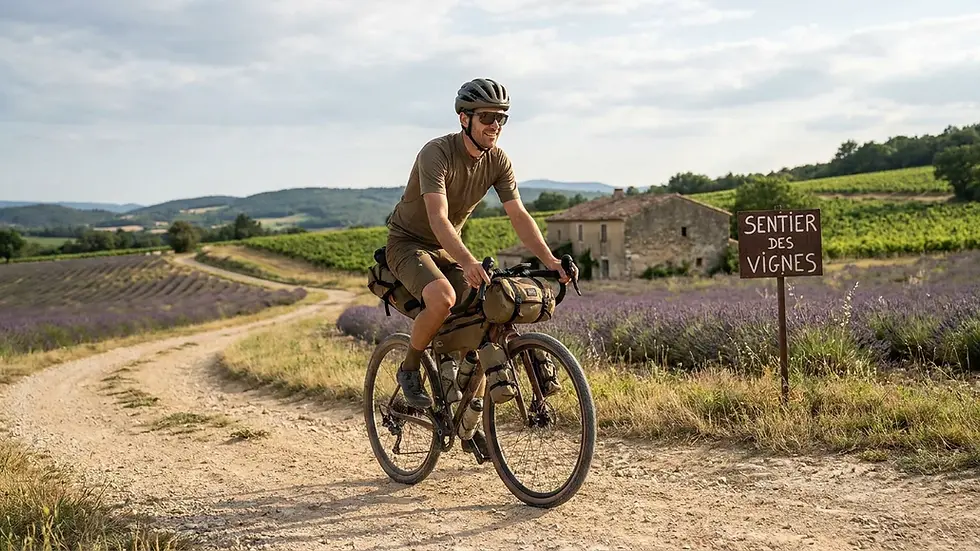
The inserts on gravel frames allow you to carry essential gear for multi-day rides. This inherent compatibility with bikepacking makes gravel bikes perfect for ultra-endurance adventures, those events that combine distances of 100 to 500 km with mixed terrain.
It is precisely within this adventure dimension that we organize our events. Our routes offer gravel trails ranging from 60 to 500 km across France, from Lyon to Bordeaux, passing through the Basque Country, Annecy, and Brittany. Each edition invites participants to discover a region from a unique perspective, combining secondary roads, gravel paths, and forest tracks.
What equipment do I need to get started in gravel biking?
Getting into gravel biking doesn't require a huge investment, but some choices deserve careful consideration.
The bicycle
For a reliable first gravel bike, expect to spend from €1,000 for an entry-level model (aluminum). Mid-range models, around €2,000, offer a good compromise between weight, comfort, and durability. Carbon frames, which are lighter (between 8 and 8.5 kg), are generally priced between €3,000 and €5,000.
Before buying, ask yourself the right questions: what is your main training ground? How often do you plan to go out? Do you want to do long distances or short outings?
Textile equipment and accessories
A helmet remains an essential accessory, whether it's a road or mountain bike helmet with a visor. A pair of glasses protects against the frequent debris encountered on gravel paths. As for clothing, gravel riding often adopts a less form-fitting style than road cycling: a special gravel jersey with pockets and comfortable cycling shorts form the foundation.
SPD-type clipless pedals (compatible with mountain bike cleats) are recommended, as they allow for easy walking on sections of the trail. Don't forget high socks to protect yourself from low vegetation, as well as a complete repair kit.
Participating in a gravel event: how to get started?
One of the best ways to discover gravel riding is to participate in an organized event. These gatherings offer a safe environment, marked routes, and above all, a friendly atmosphere that reflects the spirit of the sport.
There are several formats for gravel cycling events. Rides, without timing or rankings, are perfect for beginners. Competitive formats (granfondo, timed sections) are for cyclists who want to test themselves on a set course. In all cases, a medical certificate may be required depending on the type of event and your cycling license status.
To experience this firsthand, we offer events throughout France. Whether you're tempted by a gravel race in Brittany or our routes in the south, each event is designed to combine athletic effort with exploring the region. Our calendar also features women's gravel races with dedicated events.
Gravel riding for everyday use: a bike for (almost) everything
Beyond its use in sports, gravel bikes have become a true Swiss Army knife of cycling. Their versatility makes them a valuable asset for commuting, family rides, or weekend getaways.
Equipped with mudguards and lights, a gravel bike becomes a comfortable and efficient urban bicycle. With panniers or a rack, it transforms into a touring bike. And with thinner slick tires, it regains performance close to that of a road bike for rides on asphalt.
It is this adaptability that leads some riders to say that the gravel bike is "the bike you would keep if you could only have one." A single frame, two pairs of wheels (one for road, one for off-road), and the possibilities become almost limitless.
Gravel biking is much more than a passing fad. It's a cycling philosophy that puts exploration, versatility, and camaraderie at the heart of every ride. Whether you're looking for a bike for your daily commute, bikepacking adventures, or ultra-endurance challenges, gravel adapts to your ambitions. With events popping up all over France, now is the perfect time to hop on a gravel bike and discover new horizons. Our events combine exceptional routes, a strong sense of community, and the exploration of France's most beautiful regions for a complete and memorable gravel riding experience. To experience your next gravel adventure, register for our upcoming events and join the community.
Frequently Asked Questions
Is gravel cycling suitable for beginners?
Yes, gravel bikes are particularly well-suited to beginners thanks to their comfortable geometry, stability, and wide, shock-absorbing tires. Their versatility allows you to ride on all types of terrain without changing bikes, making them an excellent choice for starting out.
What is the difference between gravel and hybrid bikes?
Although both are versatile, a gravel bike adopts a more sporty (forward-leaning) riding position with drop handlebars, while a hybrid bike offers an upright position with flat handlebars. Gravel bikes are generally lighter and more responsive, designed for more demanding rides.
Can you participate in a gravel race without being licensed?
Yes, most gravel events are open to non-licensed riders. For competitive formats, a medical certificate less than one year old is generally required. Touring formats do not require a certificate. Our GravelMan Series events welcome all levels, with routes ranging from 60 to 500 km.

Comments